
PG vs. Co-living vs. Renting a Flat: The Young Professional's Guide in India
Deciding between PG accommodations, co-living spaces, and independent flat renting in India? Compare deposits, privacy, amenities, freedom, and legal agreements.
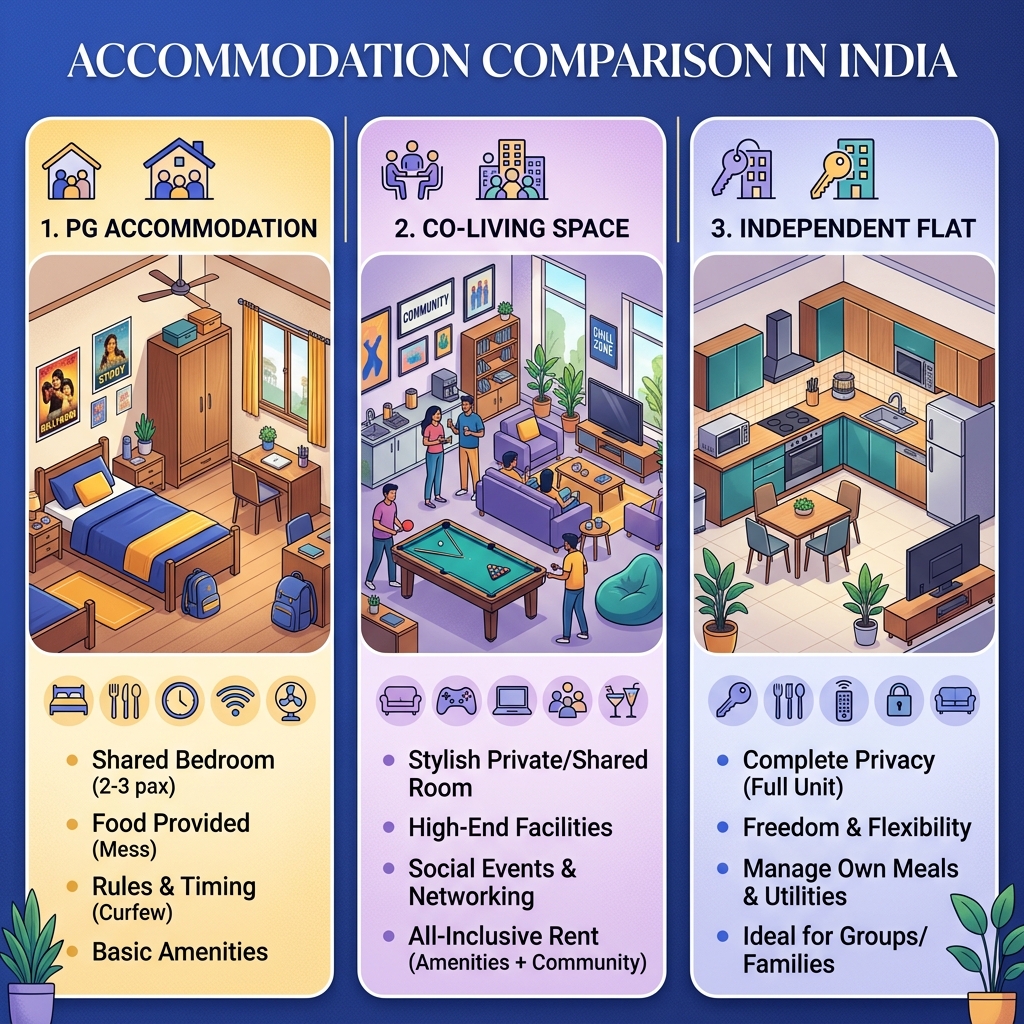
PG vs. Co-living vs. Renting a Flat: The Young Professional's Guide in India
Moving to a new city for a job or higher education is an exciting milestone. Cities like Bengaluru, Pune, Delhi-NCR, Mumbai, and Kolkata are bustling hubs attracting millions of young minds every year. However, before you pack your bags, the biggest hurdle is finding the right roof over your head.
In the modern Indian real estate landscape, you generally have three housing options:
- Paying Guest (PG) Accommodation
- Co-living Spaces
- Independent Flat Renting
Each option appeals to different budgets, lifestyles, and priorities. In this guide, we break down these three models across critical parameters like cost, privacy, flexibility, and legal compliance to help you make the right choice.
High-Level Comparison Matrix
To help you get a quick overview, let's look at how the three housing types compare side-by-side:
| Parameter | Paying Guest (PG) | Co-living Spaces | Independent Renting |
|---|---|---|---|
| Privacy Level | Low (mostly shared rooms) | Medium (private bedroom, shared lounge) | High (entire unit is yours) |
| Average Deposit | 1 to 2 months' rent | 1 to 3 months' rent | 2 to 10 months' rent (varies by city) |
| Food & Utilities | Included (set menu) | Included / Add-on subscriptions | Managed & paid by you |
| House Rules | Strict (curfews, visitor bans) | Minimal (community guidelines) | No curfews (subject to society rules) |
| Agreement Type | Minor PG license | Co-living membership contract | Stamped, registered rent agreement |
1. Paying Guest (PG) Accommodation
PGs are the traditional choice for students and fresh graduates. In a PG, you rent a bed in a shared room (single, double, or triple sharing) inside a house managed by a local landlord or operator.
Pros:
- Highly Economical: The cheapest option since rent, food, housekeeping, Wi-Fi, and electricity are wrapped into a single bill.
- Minimal Setup: Fully furnished with bed frames, mattresses, closets, and basic appliances.
- Home-Cooked Food: PGs usually have in-house cooks providing breakfast, lunch, and dinner.
Cons:
- Zero Privacy: Sharing a room with 1-2 strangers leaves little personal space.
- Restrictive Rules: Most PGs enforce strict curfew timings (e.g., gates close at 10 PM) and ban visitors of the opposite gender or even parents.
- Quality Inconsistency: Quality of rooms, Wi-Fi speeds, and food varies heavily depending on the operator.
2. Co-living Spaces
Co-living is a modern, tech-enabled evolution of PG living, managed by corporate operators (such as Stanza Living, Colive, or Zolo). It caters specifically to single young professionals who want hassle-free boarding combined with a social environment.
Pros:
- Hassle-Free Booking: Entirely managed via mobile apps—from monthly rent payments and food menus to logging maintenance complaints.
- Vibrant Community: Access to beautiful communal spaces (lounges, gaming zones, gyms, co-working areas) and weekend community events.
- Better Amenities: High-speed Wi-Fi, professional daily cleaning, laundry facilities, and round-the-clock app-supported security.
- No Curfews: Modern co-living spaces use biometric access cards, allowing you to walk in and out at any time.
Cons:
- Higher Costs: Considerably more expensive than traditional PGs due to premium services and shared amenity costs.
- Locked Services: You must pay for common facilities (like the gym or communal Wi-Fi) even if you do not use them.
3. Renting an Independent Flat
Renting a 1BHK, 2BHK, or 3BHK apartment is the choice of couples, families, groups of friends, or individuals who value independence and privacy above all else.
Pros:
- Complete Privacy & Freedom: The entire apartment is yours. No curators, no wardens, and complete freedom to host guests, paint walls, and keep pets.
- Control over Expenses: You choose your own cook, internet service provider, and manage electricity consumption directly.
- Long-Term Stability: Offers a stable home for 11 months or more with a formal lease contract.
Cons:
- High Upfront Costs: High security deposits. In cities like Bengaluru, deposits can range from 5 to 10 months' rent (though the Model Tenancy Act Guide caps this at 2 months in adopting states).
- Heavy Setup Costs: If renting an unfurnished flat, you must buy furniture, kitchen appliances, and set up utilities.
- Landlord Negotiation: Dealing with individual landlords, housing society regulations, and local brokers can be challenging.
The Legal and Agreement Differences
It is crucial to understand what kind of contract you are signing, as your legal rights depend on it:
- PG Agreements: Typically just a basic license agreement. You are a "licensee," not a tenant, meaning the operator can ask you to vacate with short notice, and you have limited tenancy rights.
- Co-living Agreements: Drafted as a commercial membership agreement. It has clear lock-in periods, notice terms, and service SLAs.
- Rent Agreements: A formal lease agreement registered with the local sub-registrar. It is heavily protected under state rental laws (like the West Bengal Premises Tenancy Act).
- Tip: Make sure you negotiate deposit returns clearly. Read our Security Deposit Guide for tips on avoid deduction disputes.
Which Should You Choose?
- Choose a PG if you are on a tight budget, don't want to worry about cooking or cleaning, and are comfortable sharing a room and following curfew rules.
- Choose Co-living if you are moving to a new city alone, want premium amenities and community networking, have a flexible budget, and value hassle-free, app-managed living.
- Choose an Independent Flat if you are moving with friends, have a higher initial budget for deposits, want complete privacy, and are ready to manage cooking, utility bills, and housekeeping yourself.
How Maakan Supports Your Rental Journey
No matter which housing route you choose, Maakan is designed to simplify your search and onboarding:
- Verified Listings: Browse verified apartments and shared spaces, saving you from fake listings and heavy brokerage fees.
- Legally Stamped Contracts: Draft and sign legally binding contracts tailored to your arrangement, with state-compliant clauses. Consult our West Bengal Rental Agreement Guide to learn more.
- Digital Inventory Checklists: Complete your move-in inspections digitally. Use our Move-In/Move-Out Checklist Guide to log existing room conditions and secure your deposit refund.
Find your ideal home today. Explore verified property listings on Maakan and take control of your rental journey. Start searching now!
Ready to Find Your Rental?
Start your no-broker rental journey across India today.